

Have We Really Found a “Psychic Gene”?
A critical examination of this popular study and what the evidence actually says

Recently, Whitley Strieber interviewed Dean Radin on the Dreamland podcast in an episode titled ‘The Terrifying Reason Many People Don’t Have Psychic Abilities’. As a result I’ve seen a small but persistent rise in online claims that scientists have found evidence some people are more likely than others to be psychic. Radin, a parapsychologist and chief scientist at the Institute of Noetic Sciences (IONS), was invited onto the show to promote his latest book. In the interview, he repeatedly refers to a recent study he co-authored examining the genetics of psychic abilities (Wahbeh et al., 2022), and then builds a much larger narrative on top of it.
So, have we actually found a psychic gene? Well…
Where This Story Comes From
The story, as it’s usually told, goes something like this. Psychic ability runs in families. A genetics study supposedly backs this up, because it looked at the DNA of people who describe themselves as psychic and compared them to people who don’t. The study reports a small but consistent difference in one tiny stretch of DNA – an intronic variant in a gene called TNRC18 – between 13 self-identified psychics and 9 controls (Wahbeh et al., 2022). IONS’ own write-up goes further and suggests this might represent a mutation that “suppresses” psychic ability in some people (Criswell, 2021).
Add in a speculative history lesson about centuries of witch trials supposedly culling psychically gifted families from the gene pool, and you end up with a dramatic explanation for why modern humans are, allegedly, less psychic than our ancestors. The study is real. The leap from odd little DNA blip to we’ve explained why you’re not psychic is where the problems start.
What the Study Actually Did
The paper is very clear about what it is: a pilot case–control study. In other words, a small, exploratory first look – not a grand discovery.
The researchers began by recruiting volunteers online. More than three thousand people completed questionnaires about their experiences and their families. From those, the team selected just thirteen people who described strong, lifelong psychic experiences and also reported similar abilities in their relatives. These became the “psychic” cases. They then selected ten people for a control group – people of similar age, sex, and ethnicity who said they had no psychic ability at all (Wahbeh et al., 2022). Everyone did some basic psychological screening to rule out things like psychosis, which is fair enough, but it doesn’t make the two groups identical in every other way.
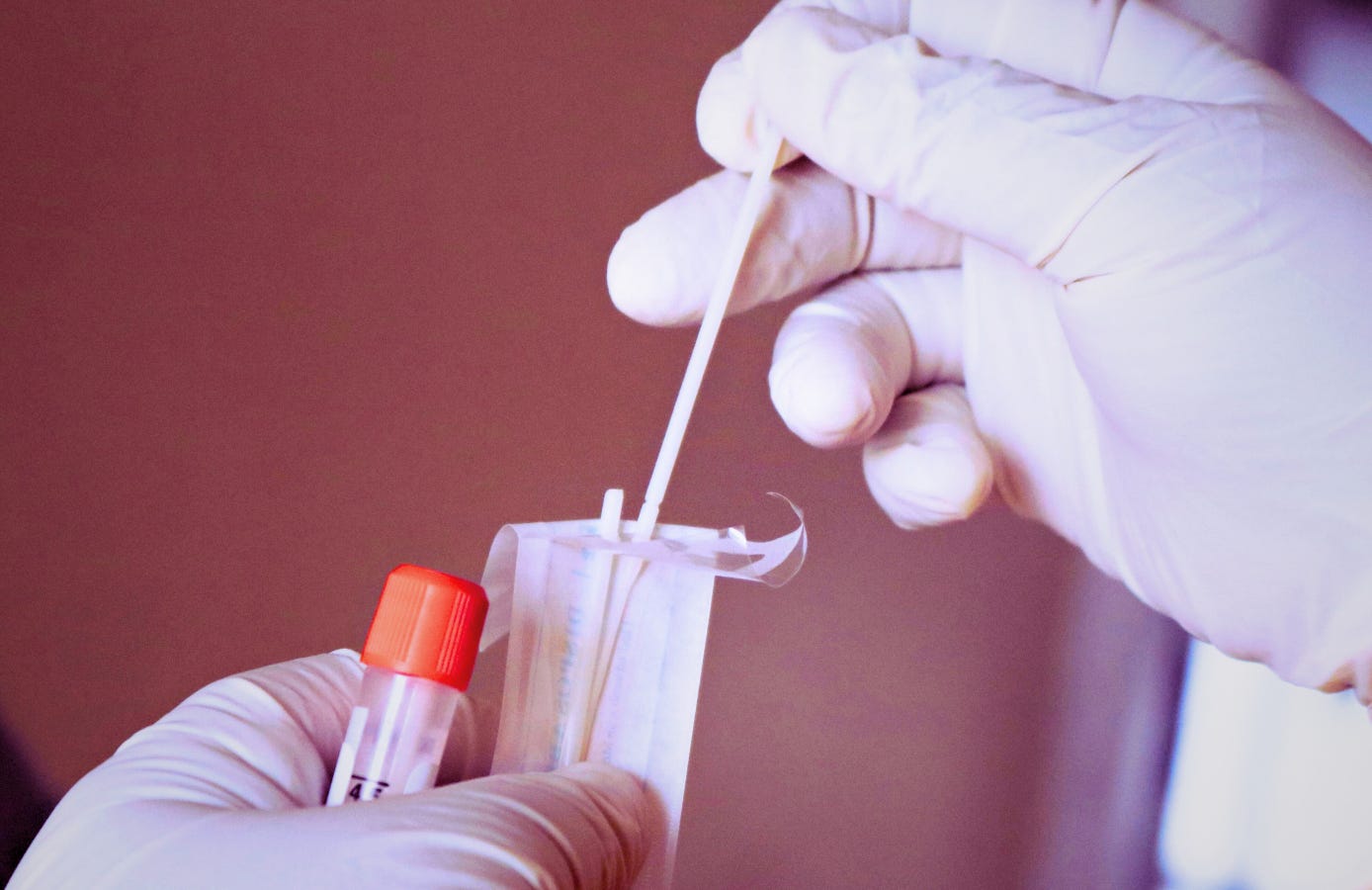
Next, the researchers took saliva samples and sequenced the parts of the genome that code for proteins – the bit geneticists call the exome – plus some nearby non-coding stretches for good measure (Wahbeh et al., 2022; Veritas Genetics, 2024). They then compared the DNA of the psychic group and the control group to see if anything stood out.
In the protein-coding parts of the genome, they didn’t find anything that reliably separated psychics from those in the control group. There was no neat “psychic gene” sitting there. When they widened the net to include some non-coding regions, they did find one small difference - a particular DNA variant in an intron – a non-coding section – next to TNRC18 showed up more often in the controls than in the psychics.
And that’s it. That’s the core finding.
To their credit, the authors are quite cautious about what this means. The abstract explicitly notes the tiny sample size and says that random sampling could explain the pattern they saw. They describe the result as ‘provocative’ and say it needs replication in larger studies – which is exactly what you’d expect from a pilot (Wahbeh et al., 2022).
What it is not, is proof that some people are genetically destined to be psychic.
Why This Doesn’t Prove Anyone Is “Genetically Psychic”
You don’t need a genetics degree to see the problems here, you just need to be clear on what the data can’t tell us.
First, the numbers are small to the point of being fragile. We are talking about thirteen people in the psychic group and ten in the control group. That would be a worryingly small sample even for a basic psychology study. For DNA, where you are comparing lots of different positions across the genome, it’s tiny.
If you go fishing through thousands of positions in the genome with only 23 people, it’s not surprising that you find something that differs between the groups. If you give me two small groups of people and let me compare them on enough measures – height, shoe size, favourite biscuits – eventually I will find a difference that looks interesting just by chance. Geneticists worry about this all the time, and it’s why robust genetic studies on complex traits usually involve far larger samples – often tens or hundreds of thousands of people – and very strict rules about what counts as a real signal.
Even if you take this particular DNA difference at face value, it still doesn’t show that the variant reduces psychic ability, or that lacking it causes psychic skills. All it shows is that in this small, highly self-selected sample, people who identify as psychic didn’t carry that variant, and some non-psychic controls did - plenty of other explanations are possible, including pure statistical fluke.
We also have no idea how common this variant is in the wider population. To tell a big story about so-called psi-suppressor genes spreading through humanity, you’d need to know how frequent this variant is in large, representative samples from different populations, and whether there is any sign it has been under selection – in other words, becoming more common over generations because it had some advantage. None of that is in the pilot. There’s no population-level data – just those twenty-three people. So, any sweeping claims about why many people today aren’t psychic are leaping far beyond what the data can support.
Biologist P.Z. Myers (2021) makes a similar point in his own commentary on Radin’s genetics talk: with a sample this small, and such a huge search space, “provocative” blips are exactly what you’d expect to see by accident.
Let’s Not Forget About the Witch Hunts
Radin doesn’t stop at the genetics, though. In the interview, he links the variant to a larger historical narrative - the idea that witch trials and the persecution of mystics effectively culled psychically gifted families from the gene pool. It’s a powerful story, and it doubles as strong book promotion – we’re in the territory of real magic and a persecuted, magical past.
But as an argument about genes, it has serious problems.
For this to work as a genetic explanation, you have to quietly accept the witch-hunters’ own premise and assume that people accused of witchcraft and heresy were, in fact, unusually mystical or psychic, and that authorities were somehow successfully targeting a real underlying trait rather than simply persecuting whoever was convenient. History doesn’t support that. Witchcraft accusations overwhelmingly tracked gender, poverty, and marginalisation, and were deeply embedded in neighbourly feuds, property disputes, and religious panics (Briggs, 1996; Sharpe, 1997). Witch or mystic in this context is a social label, not a diagnosis of genuinely magical people.
Even if, very generously, you assumed that some victims genuinely did have unusual abilities, you would still need to show that they were killed at a rate that disproportionately removed specific genetic variants, and that this removal was large and sustained enough to measurably shift gene frequencies across whole populations. That’s the kind of claim that normally requires heavy-duty population genetics; in this case, it’s simply asserted.
There is also an ethical issue in how this history is used. Recasting witch-hunt history as we killed the real psychics risks downplaying the role of misogyny, poverty, and social power, and glossing over torture, forced confessions, and show trials. It turns genuine human suffering into a tidy myth in service of a modern story about psychic genes.
What About the Other Evidence?
All of this is layered on top of the contested foundation of the broader evidence for psi. In the interview and in his book, Radin folds the genetics into a worldview where consciousness is fundamental, psi phenomena are real but subtle, and magic is essentially the disciplined use of intention. To support this, he points to meta-analyses of telepathy and precognition experiments, random-number generator studies where people try to mentally nudge their output, and double-slit experiments where focused attention allegedly shifts quantum interference patterns.
Those results are themselves heavily debated. Critics have raised concerns about very small effect sizes, publication bias (failed studies quietly disappearing), flexible analyses, and the general difficulty of independently replicating positive findings under stricter controls (Milton & Wiseman, 1999; Wagenmakers et al., 2011; Reber & Alcock, 2020). Even if you personally find some of those anomalies interesting, they are a long way from the kind of robust, predictive, independently replicated evidence you’d want before declaring that magic and genetics have just rewritten our picture of human nature.
And that is really the core problem - each step of the argument is already controversial before you even start stacking them on top of each other.
So, Have We Really Found a “Psychic Gene”?
The reality is closer to this - we have one small, exploratory exome study showing a single intronic variant difference between thirteen self-identified psychics and ten controls; we have a romanticised reading of witch-hunt history that treats accusations as if they mapped neatly onto a real, heritable psychic trait; and we have a set of parapsychological findings with tiny effects that are still being argued over in the literature. Stitched together, they make an engaging story about psi-suppressor genes and a persecuted magical past. As storytelling, you can see the appeal. As science, it’s a castle built on sand.
None of this means that research into unusual experiences is worthless, or that genetics could never tell us anything about why people differ in how they perceive and interpret the world. It is entirely reasonable to be curious about why some people report vivid premonitions or apparitions while others never do. However, if we care about evidence, we have to resist the urge to let one small study become proof of a grand theory.
If a future, large, preregistered, independently replicated genetics project finds robust, functionally understood differences between people with and without unusual abilities, that would be genuinely newsworthy. It still wouldn’t tell us that those experiences are paranormal – psychology and culture would still be in the mix – but it might tell us something interesting about perception, imagination, or how our brains filter reality.
Until then, the honest answer to “Have we really found a psychic gene?” is simple: no. What we’ve shown, at best, is that if you look very hard at the DNA of twenty-three people and you really love the idea of magic, you can spin an awful lot of story out of one tiny blip.
References
Briggs, R. (1996) Witches and Neighbours: The Social and Cultural Context of European Witchcraft. London: HarperCollins.
Criswell, R. (2021) ‘How Psychic Suppression May Impact the Heredity of Psi-Genes’, Institute of Noetic Sciences (IONS), 21 August. Available at: https://noetic.org/blog/how-psychic-suppression-may-impact-the-heredity-of-psi-genes
Milton, J. & Wiseman, R. (1999) ‘Does psi exist? Lack of replication of an anomalous process of information transfer’, Psychological Bulletin, 125(4), pp. 387–391.
Myers, P.Z. (2021) ‘Plumbing the depths of psychic research’, Pharyngula, Freethought Blogs, 10 May. Available at: https://freethoughtblogs.com/pharyngula/2021/05/10/plumbing-the-depths-of-psychic-research/
Reber, A.S. & Alcock, J.E. (2020) ‘Searching for the impossible: Parapsychology’s elusive quest’, American Psychologist, 75(3), pp. 391–399.
Sharpe, J.A. (1997) Instruments of Darkness: Witchcraft in England 1550–1750. London: Penguin.
Veritas Genetics (2024) ‘Exome vs. genome: which type of test to choose?’, Genes Matter blog, 31 January. Available at: https://www.veritasint.com/blog/en/exome-vs-genome-which-type-to-choose
Wahbeh, H. et al. (2022) ‘Genetics of psychic ability – A pilot case-control exome sequencing study’, Explore, 18(7), pp. 725–734.
Wagenmakers, E.-J. et al. (2011) ‘Why psychologists must change the way they analyze their data: The case of psi’, Journal of Personality and Social Psychology, 100(3), pp. 426–432.
What I find funny about the way this study seems to be written is the implicit assumption that everyone would want to be psychic