


There are some paranormal stories the media simply cannot resist. Haunted dolls, cursed objects, celebrity psychics. And, every so often, the tabloid favourite: the woman who says she is in a romantic relationship with a ghost.
You can almost set your watch by how these stories get treated. A headline written with all the delicacy of someone throwing a custard pie at the supernatural, intended to produce cheap laughs and raised eyebrows before everyone moves on. What you almost never get is anything more interesting than that. No curiosity, context, or attempts to explore what might actually sit underneath such claims, beyond the easy thrill of “look at this ridiculous woman and her spectral boyfriend.”
But that is the boring version of the story.
The more interesting version starts from a much less glamorous truth - human beings are actually very good at having strange experiences, and not all of them fit neatly into the polite boxes of ordinary life. Shocking, I know. The field of Psychology has a term that is useful here: felt presence. It refers to the sense that someone or something is there, nearby, even when there is no clear sensory evidence of another person. Some people reading this may have experienced this. It’s an experience that’s not just the stuff of ghost stories and has been discussed in relation to bereavement, neurological conditions, psychosis, spiritual practice, anxiety, and physically or psychologically taxing situations. In fact, a large 2024 population study found that 1.6% of participants reported a felt presence in the past month, and that these experiences were associated with loneliness, poor sleep, adverse events, and other hallucinatory or delusion-like experiences.1
That does not mean every “ghost lover” story has a neat medical explanation, still less that strangers in the press should be diagnosed from the comfort of your sofa. Instead, it shows us how the raw experience itself - the feeling that an unseen other is present, attentive, maybe even interactive - is a recognised part of human experience. In other words, the sensation may be real as an experience even if the explanation attached to it is doing a lot of cultural work. Research on anomalous experiences makes exactly this distinction: between the experience someone has and the paranormal attribution they give it afterwards. 2
Sleep is another big piece of the puzzle. Sleep paralysis is far from rare, and one systematic review found lifetime prevalence rates of 7.6% in the general population, rising much higher in students and psychiatric samples. These episodes can involve waking immobility, terror, chest pressure, tactile sensations, and the overwhelming conviction that there is another presence in the room.3 As a ghost researcher, the strangest stories of sleep paralysis I’ve encountered from members of the public who contacted me for help involved a person who would wake to see a giant frog sitting on their chest, and another who got hugged by an unseen presence from behind. Not nice.
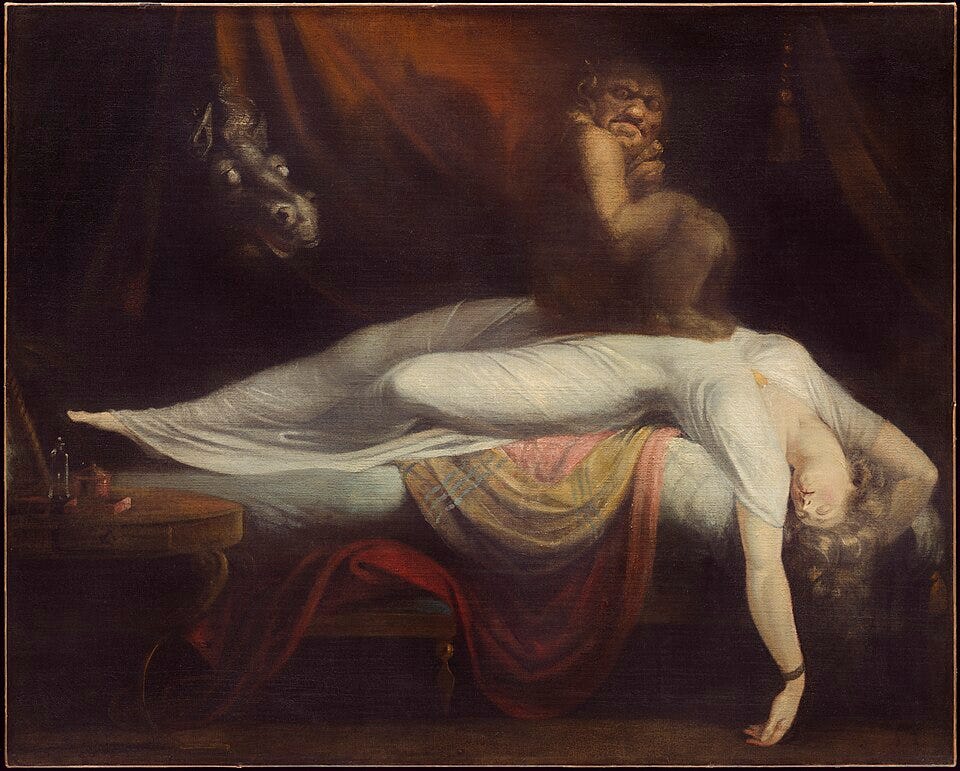
There is also so-called incubus phenomenon, a sleep-related experience involving paralysis, a sensed entity, bodily pressure, and sometimes explicitly sexual sensations. A meta-analysis estimated its lifetime prevalence at around 11% in the general population and 41% in selected at-risk groups. That does not prove ghost sex, obviously, but shows that intensely physical, intimate-feeling experiences involving an unseen presence are not some impossible absurdity dreamt up by tabloids for a slow news day.4
Then there is grief, which has always sat uncomfortably between psychology, religion, and folklore. Bereavement researchers have long noted that many grieving people report sensing the presence of the dead. Sometimes that means hearing a voice, smelling a familiar perfume, or feeling a touch. Sometimes it’s less sensory than that - just a vivid, inexplicable sense that someone beloved is there. Reviews of this literature suggest these experiences are often benign and need to be understood in their personal, relational, and cultural context, not flattened immediately into pathology. That matters because once you accept that people can experience the dead as emotionally and even physically near, the leap from presence to relationship starts to look less like nonsense and more like a human attempt to narrate something unusual using the language available to them.5
And that, really, is the key point…
Experiences like this do not arrive with subtitles. People have sensations, impressions, bodily states, dreams, half-waking episodes, grief reactions, and moments of intense emotional conviction and culture hands them a script. In one context the unseen presence is interpreted as a demon, in another it is a spirit guide. To someone else it is a dead spouse, an angel, a haunting, or simply “something odd that happened when I was exhausted.” Folklore has always provided templates for intimate encounters with unseen beings - modern paranormal culture just gives those old ideas a fresh haircut and a media strategy.
That’s also why the gendered side of these stories is worth noticing. Some research has found that women are more likely than men to report belief in many paranormal phenomena, and the large felt-presence study found women overrepresented among those reporting the experience. At the same time, we should not be naive about media selection. “Woman says she has a ghost lover” is not just a paranormal story but also a story about femininity, sexuality, weirdness, and public spectacle. It fits a very old cultural pattern in which women’s claims about bodies, desire, mysticism, and the unseen are made both hyper-visible and faintly ridiculous. Even if women were not more likely to report certain beliefs or experiences - and in some areas they do seem to be - editors would still be more likely to package these stories in ways designed to invite mockery.6
Media plays another important role here, too. People don’t make sense of unusual experiences in a vacuum and a 2024 study found that viewing paranormal documentaries and reality TV, following paranormal news, and even using YouTube for paranormal content predicted stronger belief in hauntings. That doesn’t mean if someone watches enough ghost television they suddenly develop a supernatural situationship, but instead that contemporary culture supplies ready-made ways for explaining experiences that are already emotionally powerful, confusing, or intense. If your world is full of paranormal language, then the paranormal becomes one of the easiest ways to narrate what happened to you.7
This is why I find the point-and-laugh coverage so unsatisfying. It tells us almost nothing interesting and reduces a potentially rich topic - belief, embodiment, loneliness, sexuality, grief, suggestion, culture, sleep, folklore - to a punchline. And frankly, we can do better than that. I do not believe in literal ghost boyfriends, but I do believe that people can have vivid, intimate, frightening, comforting, or socially meaningful experiences that they then interpret through a supernatural frame.
That, to me, is the real story. Not the question of “is ghost sex real?” but “what kind of human experience becomes legible as ghost sex in the first place?” Once you ask that sort of question, the whole thing gets a lot less silly and a lot more revealing because beneath the daft headlines and the easy jokes, this is not really a story about ghosts but instead an exploration of how people make meaning out of the strange things their minds and bodies sometimes do, and about how eagerly the rest of us turn that into entertainment.
The Ghost Geek is an award-winning science blog about spooky things, written by Hayley Stevens, a former ghost hunter who is now studying for a Master’s in Forensic Psychology and uses scientific scepticism to investigate strange claims.