

My First AI Ghost Photo
Modern ghost problems for modern ghost geeks...

Earlier this month, someone sent me a photograph that they thought might show a ghost. The story goes:
I visited my Aunt and Uncle’s house for Christmas morning and we were taking some photographs in the lounge just before opening gifts. In this photo, there appears to be a white figure stood between the Christmas tree and the wall next to the window. There was no space there for a person to fit and nobody is unaccounted for in the photo for them to have accidentally been stood there. My aunt (in the green top and red trousers) believes it’s the ghost of her father.
It’s a familiar enough moment if you work in paranormal research: someone getting in touch because they’ve been spooked by a slightly uncanny image that shows a vague human-shaped form in the background, and that hopeful question - what do you think? In this case, the ghost is said to be a large white apparition standing behind a Christmas tree, half-obscured, easy to miss at first glance and impossible to unsee once pointed out.
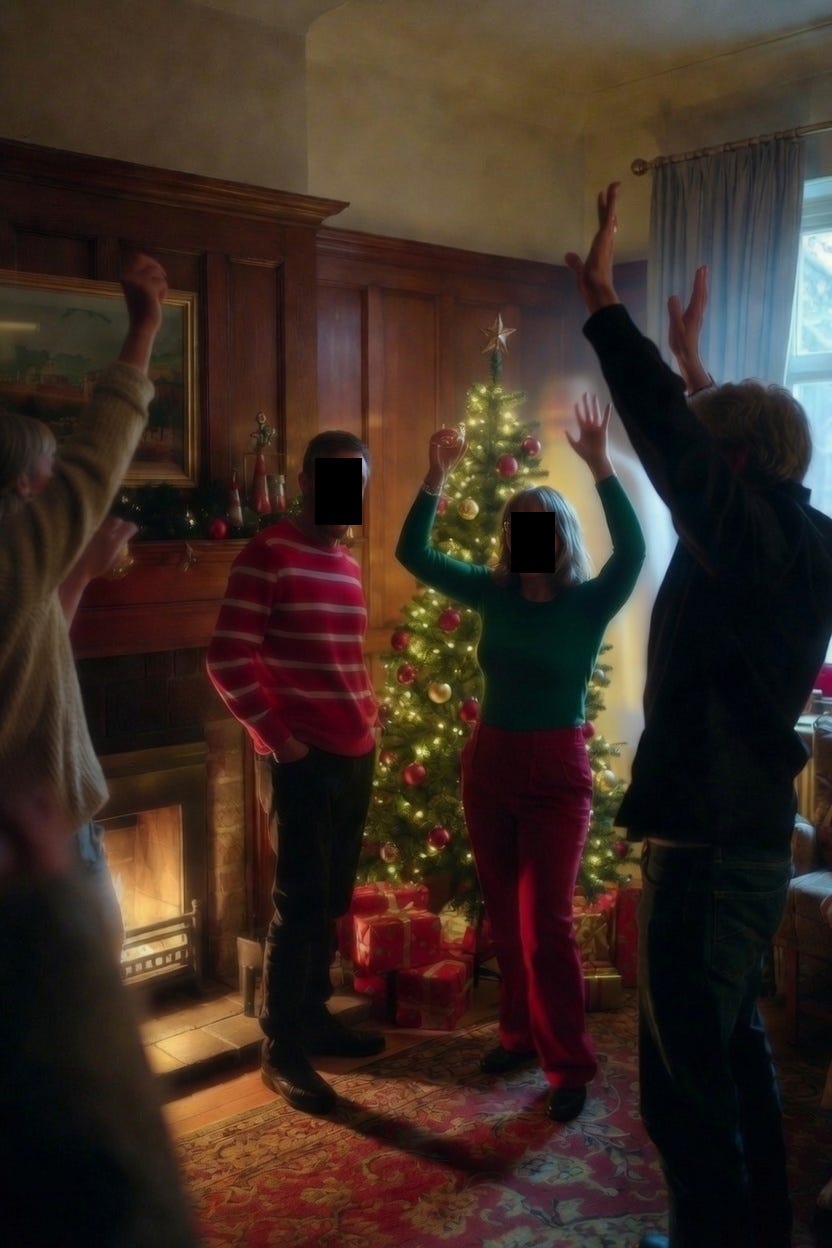
My assessment is that the image isn’t paranormal at all - but it is interesting. Because this is the first time I’ve been asked to assess what I’m confident is an AI-generated ghost photo. I asked the sender for further photos from the set of those taken on that morning because I’d like to rule out that this was AI generated and I’ve heard nothing back in just over a week.
At first glance, the image presents itself as a candid festive scene: a group of people celebrating in a cosy living room, arms raised, a Christmas tree lit behind them. But on closer inspection, multiple elements don’t behave as real photographs (or places) do.
There are anatomical issues - a hand holding a wine glass that doesn’t convincingly grip it, fingers posed without a sense of pressure or weight. Decorative objects on the fireplace mantel resolve into vague, incoherent shapes rather than recognisable ornaments. A framed picture above the mantel has a border that exists only along its top edge, a structural failure that’s very common in generative imagery. The pattern on the rug looks weird, and the presents under the tree seem to merge.
Also, this is supposed to be a photo of people cheering but it looks instead like a room full of people holding their arms up in the air and keeping them still. Are they being held at gun point?
Lighting is another giveaway. The entire scene is bathed in a uniform, nostalgic glow that ignores the logic of competing light sources. The Christmas tree lights, the window, and the fireplace should be arguing with one another; instead, everything is evenly and politely illuminated. There’s motion without motion blur, softness without depth of field, and texture that smears rather than resolves - particularly in busy areas like wrapping paper, rugs, and baubles.
Taken together, these are not the quirks of a strange photograph but the fingerprints of image generation.
Which brings us to the “ghost” itself.
It is incredibly well placed and would make for a genuinely good, spooky ghost photo if this was genuinely as presented in the claimed story. The figure is human-sized, upright, centred behind a culturally loaded object, and partially obscured in a way that feels intentional rather than accidental. It almost looms there, watching over the people, unseen on the edge of the lively revelry in stark blues and whites which contrast to the warm colours of the living. This doesn’t look like an AI mistake that happened to resemble a ghost. It looks like an image prompted to contain one, but subtly enough to invite debate.
This is nothing new. People have been adding ghosts to photographs for as long as photography has existed. From Victorian spirit photography and double exposures to later darkroom tricks and digital edits, the desire to insert the uncanny into everyday images is not new. What has changed is simply the ease with which it can now be done.

AI image generation doesn’t create a new category of ghost photograph so much as it provides a new method for an old one. Instead of glass plates or Photoshop layers, we now have prompts and iterations. The intent - to produce something suggestive, ambiguous, and emotionally compelling - remains much the same.
That’s why it’s important not to treat images like this as unprecedented or especially threatening. They don’t require panic, and they don’t require paranormal explanations. They require the same thing ghost photographs have always required: careful attention to how images are made, how they circulate, and how easily human perception fills in the gaps.
In this case, what’s being identified as a “ghost” isn’t an unexpected anomaly in a genuine photograph. It’s a deliberately shaped something in a synthetically generated image - designed to be noticed only after the fact. To suggest from the edge of the room.
This may be my first AI ghost photo, but it won’t be the last. And like every ghost image before it, it tells us far more about human expectation, storytelling, and belief than it does about the afterlife. Spooky.