


The Estes Method is the latest trend sweeping through ghost-hunting circles. It claims to offer a more accurate way of communicating with spirits.
So, what’s the deal?
According to the Week in Weird website, the idea was conceived by ghost tour operators hosting public ghost events at the Stanley Hotel. Greg Newkirk writes that the trio wondered what would happen “if they isolated the noise from an SB7 Spirit Box … and fed it into a person, making them the Receiver”.
For anyone unfamiliar with ghost-hunting tech, a Spirit Box is a device which rapidly sweeps through radio frequencies. This produces a jumbled mix of audio snippets from different stations, with plenty of noise throughout. The hypothesis among ghost enthusiasts is that ghosts (or other entities) can somehow manipulate this audio to deliver messages.
The Estes Method builds on this idea by adding noise-isolating headphones and a blindfold. The person wearing them becomes the “Receiver”, listening to the Spirit Box and calling out whatever words or sounds they think they hear. Another investigator, the “Operator”, asks questions which the Receiver is not supposed to hear.
On the face of it, this seems like a sensible attempt to address one of the most obvious problems with ordinary Spirit Box sessions.
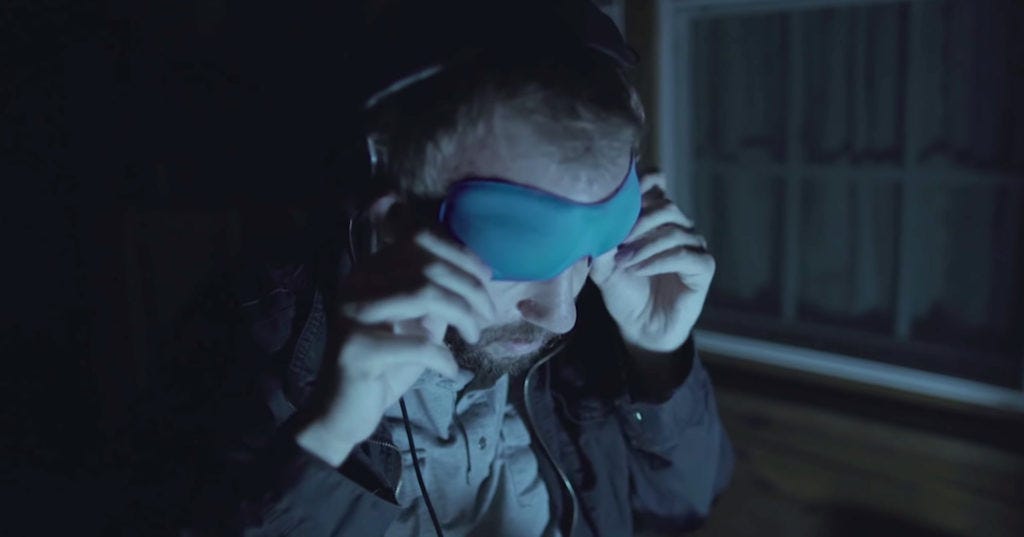
An Illusion of Control
Trying to introduce controls into ghost-hunting experiments is something I think should be encouraged. Good controls help us work out whether the thing we’re interested in is actually responsible for the results we’re seeing.
One of the main problems with ordinary Spirit Box communication is that everybody present usually knows what question has just been asked. When the resulting audio is already ambiguous, that prior knowledge can influence which fragments people pick out and how they interpret them as answers.
Relaying the audio through headphones to one person who cannot hear the questions is an attempt to overcome that problem.
The difficulty is that it doesn’t remove interpretation from the experiment.
The Receiver is still listening to ambiguous snippets of radio audio and deciding what those snippets sound like. They will also usually know something about the location or alleged haunting being investigated, and that information may influence what they hear or which fragments seem important enough to take notice of and consider as worth reporting.
The Operator has their own prior knowledge too. They know what is supposedly haunting the location, they know what questions they have asked, and they hear the Receiver’s answers as the session unfolds.
This creates another potential problem. The Operator may start changing the questions they ask in response to what the Receiver is saying. They don’t have to deliberately manipulate anything for this to happen; when you’re trying to hold a conversation, adapting what you say according to the response you’ve just received is an extremely normal thing to do.
We see examples of this happening during Estes Method sessions in the Hellier documentary, and on US ghost-hunting television where the method has become popular.
Then there are all the things the Receiver says which apparently have nothing to do with the questions being asked.
Let’s call these extraneous statements.
If a Receiver says twenty things during a session and only three appear to correspond with the Operator’s questions, those other seventeen responses matter. Yet there is an obvious temptation to remember or share the impressive-looking three and forget about the rest.
That’s cherry-picking.
Alternatively, an apparently meaningless statement might later be fitted into the haunting narrative after somebody notices that it could relate to something else: a name associated with the building, something another investigator experienced earlier, or perhaps something discovered afterwards.
Again, nobody has to be dishonest for this to happen. People are trying to make sense of what they’ve experienced.
The problem is that unless investigators decide beforehand what will count as a meaningful response, and record all of the responses rather than just the interesting ones, it becomes extremely difficult to work out whether the method is producing anything more impressive than coincidence.
There is another possible source of information leakage too.
Newkirk recommends using noise-isolating headphones of the sort used by studio drummers, specifically to prevent the Receiver from hearing the Operator’s questions. But unless investigators actually establish that the Receiver cannot hear anything happening in the room, rather than simply assuming the headphones have achieved this, that isn’t necessarily a reliable control either.
A very simple test would be to have somebody speak normally in the room while the Spirit Box is running and check whether the Receiver can detect anything at all.
If they can, even occasionally, the isolation isn’t doing the job the experiment requires of it.
So although the Estes Method certainly looks more controlled than a conventional Spirit Box session, I’m not convinced that the changes remove enough of the opportunities for interpretation, information leakage and selective reporting to justify treating the resulting responses as scientifically controlled evidence.
What About Ganzfeld?
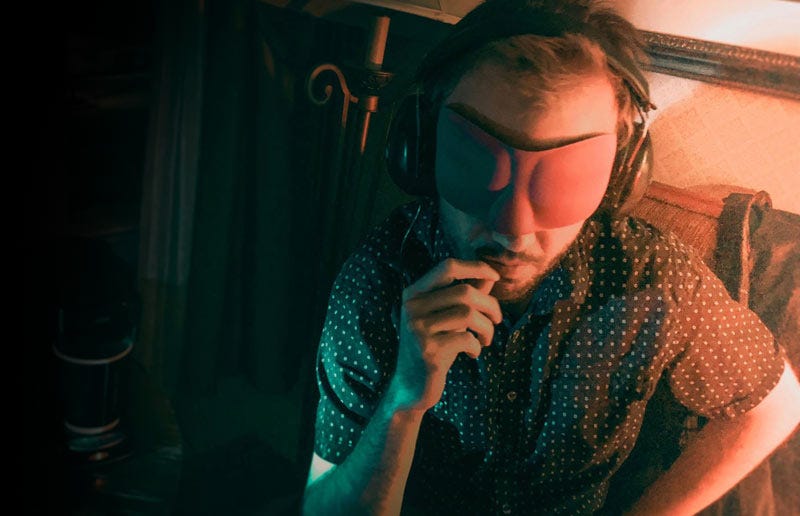
Comparisons are sometimes made between the Estes Method and Ganzfeld experiments in parapsychology, largely because both involve deliberately restricting sensory information available to a participant.
But that’s about where the useful comparison ends.
In a typical Ganzfeld experiment, the Receiver listens to uniform noise through headphones while their visual field is restricted, traditionally using red light and halved ping-pong balls over the eyes. Meanwhile, somebody in another room concentrates on one of several possible target images. The Receiver later attempts to identify the target.
Whatever conclusions somebody reaches about Ganzfeld research itself, that experimental structure doesn’t make the Estes Method scientific simply because both involve headphones and reduced sensory input.
In the Estes Method, the Receiver is still being presented with meaningful external material: fragments of speech from radio broadcasts. The question isn’t whether their brain produces information in the absence of sensory input, but whether the words they pick out of that ambiguous audio correspond to questions being asked elsewhere in the room.
That requires a rather different set of controls.
Hearing What You’re Looking For
A good example of the problem already exists outside of the Estes Method.
A British ghost hunter once presented a Spirit Box recording in which she believed a voice could be heard saying:
“Brady heard that.”
The session was being conducted while looking for alleged spirit messages from murderer Ian Brady, so in that context those words sounded potentially significant.
There was just one problem the sound wasn’t from a spirit delivering a warning about Brady, it was the Radio X station ident being chopped apart by the scanning Spirit Box.
Listen for yourself:
Original “Brady heard that” audio:
Radio X radio ident in full:
This is the problem with interpreting fragmented radio audio. Once somebody is listening for a particular person, name or answer, an ambiguous sound can suddenly seem remarkably specific.
The original interpretation wasn’t necessarily dishonest and that’s precisely why this matters.
We all like to think we’re good observers, and knowing that expectation can influence perception doesn’t magically make us immune to it. I’ve written before about how easy it is for coincidences and ambiguous information to acquire meaning once we already have an idea of what we’re looking for.

The Estes Method tries to address part of that problem by ensuring the Receiver doesn’t hear the question and that’s a worthwhile idea.
But it doesn’t remove the ambiguity of the audio itself, the Receiver’s knowledge of the investigation, the Operator’s interpretation of the answers, or the tendency for apparently meaningful responses to be remembered while meaningless ones disappear from the final account.
Those are not minor details. They’re exactly the things we need to control if we’re trying to establish whether something unusual is actually happening.
A Word of Caution…
There is one other aspect of the method which deserves mentioning.
In his article, Greg Newkirk states that the headphones should be plugged into the Spirit Box’s “spout” jack because it is much louder and helps to rule out fraud, adding that the SB7 should be set to scan “at the loudest possible volume”.
I’d be cautious about that advice.
Listening to very loud audio through headphones for extended periods can damage hearing, and producing stronger isolation from the room shouldn’t require putting the Receiver’s hearing at risk.
Trying to improve an experiment is admirable. I genuinely mean that. The Estes Method exists because ghost hunters recognised a problem with the way Spirit Box sessions were being conducted and attempted to do something about it.
But adding controls isn’t quite the same thing as controlling an experiment.
Unless investigators can rule out information leakage, account for every response rather than just the impressive ones, reduce the effect of prior knowledge and establish in advance what would count as a meaningful correspondence, the Estes Method still leaves too much room for interpretation to tell us whether anybody is really talking back.
The Ghost Geek is an award-winning science blog about spooky things, written by Hayley Stevens, a former ghost hunter who is now studying for a Master’s in Forensic Psychology and uses scientific scepticism to investigate strange claims.