

The Skeptic Who Got Hit by a Ouija Board
That time I was minding my own business and took a talking board to the face...

I’ve owned a Ouija board for decades, though I do not use it.
It lives in my house for aesthetic purposes, which sounds faintly ridiculous, but there we are. Some people have tasteful ceramics or framed botanical prints. I have an original Parker Brothers Ouija board, kept mostly because it looks good, has cultural history attached to it, and occasionally makes visitors react in exactly the way you would expect visitors to react when they realise there is a Ouija board nearby.
I was reminded of it because of a discussion on BlueSky. Dr Jo Kershaw had written, as part of an ongoing thread:
“Ouija boards are peculiar, because they absolutely were just made up as a parlour game, but they do seem to have a much higher strike rate (and I’m agnostic as to why) for people seriously frightening themselves than more obviously ‘serious’ esoteric stuff like tarot.”
My first response was, admittedly, quite blunt: Er… the key here is the people.
Not because the observation is wrong. Ouija boards do seem to frighten people in a way many other divinatory or esoteric tools do not. Plenty of people who are relaxed about tarot cards, pendulums, astrology apps, ghost stories, or haunted locations will still draw a firm line at the Ouija board.
They might not even believe in it. In fact, some of the strongest reactions I’ve heard come from people who are very clear that they do not believe Ouija boards literally contact the dead.
They still don’t want to touch one.
That, to me, is where the interesting bit begins - not with the board, but with the people around it.

Because the Ouija board itself is not peculiar in any especially mystical sense. It is a board with letters, numbers, yes, no, goodbye, and usually a planchette. Historically, it belongs as much to the world of parlour games, novelty objects, entertainment, and spiritualist-adjacent commercial culture as it does to anything more solemn or occult. Its peculiarity does not live in the cardboard, wood, or plastic.
It lives in us.
We bring things to it before we ever place a finger on the planchette. We bring horror films, sleepover dares, warnings from relatives, religious messaging, urban legends, and the accumulated cultural knowledge that tells us: this object is not neutral.
The board does not have to do anything dramatic to affect the room. It has already been cast in a role. Which is why my long-running joke has always been that the only real danger a Ouija board poses is if someone hits you round the head with it.
Then, one morning, mine hit me in the face.
I should state for accuracy that the board was not wielded by a person, nor launched by a spirit. There was only gravity, bad storage, and physics.
The board and its box are much bigger than people expect, and I had stored it on top of my wardrobe because that is the only flat-ish space in my room it fits. Unfortunately, I had clearly not stored it flat enough. Something at the back of the wardrobe top must have lifted it slightly, creating a very gentle slope and every time I opened or closed the sliding wardrobe doors, the vibration shifted the box forward by a tiny amount.
Which is how one morning I stood in front of the wardrobe, bleary-eyed and still in my pyjamas, trying to get my outfit ready for the day ahead, when I heard a strange friction sound directly above me and looked up just in time to see the Ouija board heading towards my face.
I had exactly enough time to close my eyes before it struck me across the top of my nose and brow. I started the day stood there, in my pyjamas, holding a Ouija board, thinking: “well, that felt a little ominous.”
I do not think the Ouija board was trying to send me a message. I think the message, if there was one, was probably ‘store large rectangular objects more responsibly’, but I would be lying if I said the moment did not feel like a wink from the universe.
For years I had joked that blunt force trauma was the only real Ouija board danger. Then the Ouija board delivered. Har Har.
Now, if a Monopoly board or Scrabble had fallen on my face, I would have been annoyed but because it was a Ouija board, the incident instantly became a story. The same physical event, filtered through a different object, felt different.
That does not mean it was different, just that it felt like it for a moment, because the brain in my head is really good at making meaning.
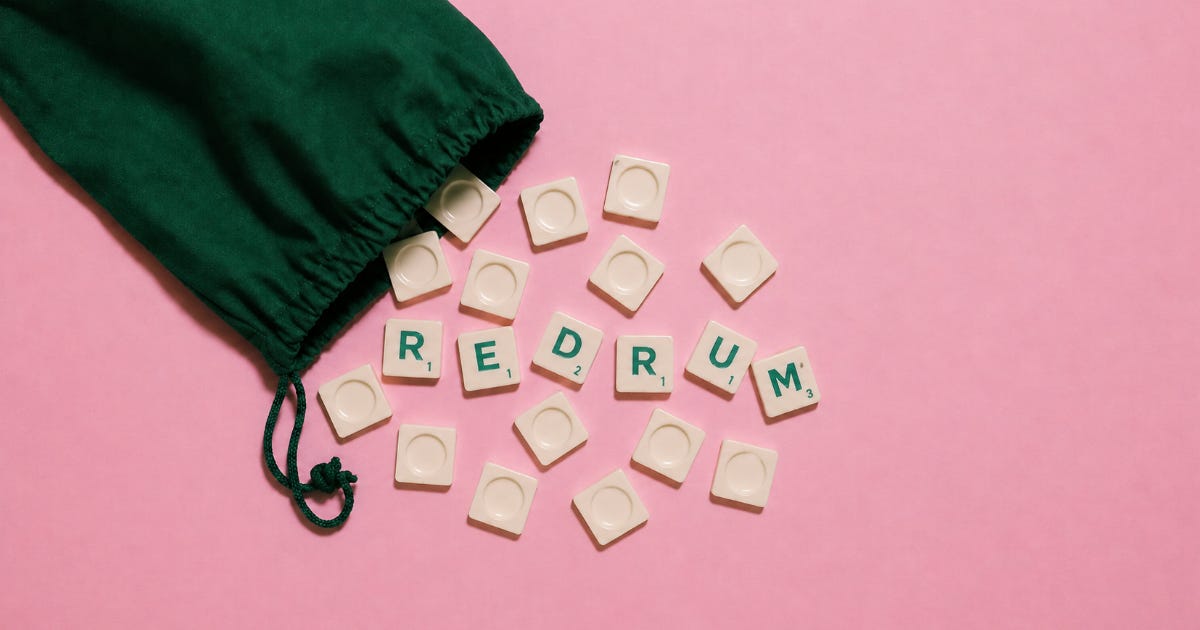
This particular board already came with a story attached, too. I bought it from a man who lived a few towns over, and he delivered it to my door himself. When he arrived, he told me he had to smuggle Ouija boards in and out of his house because his gran considered them evil.
I loved this immediately.
Not because I thought his gran was correct, but because it was such a perfect little piece of living folklore. A mass-produced Parker Brothers board game being treated as contraband. A commercial object with the social life of a cursed artefact. Something sold, collected, hidden, feared, joked about, and whispered around.
Before I ever owned it, this board was already carrying someone else’s story.
And that matters, because objects do not only exist materially - they also exist socially. A Ouija board is a physical object, yes, but it is also a bundle of associations. People respond not just to what it is, but to what they think it means.
That is not foolishness but normal human cognition.
We use pre-existing cultural and social knowledge to decide how to behave and respond to information. We interpret ambiguous experiences through expectation. We notice the things that confirm the story we already know and react to atmosphere, context, memory, suggestion, and the reactions of the people around us.
So when people frighten themselves with Ouija boards, I am less interested in asking “what is the board doing?” and more interested in asking “what are the people doing?”
This is also why I do not think this can be reduced to ‘believers are gullible’ or ‘skeptics are immune’ divide. It’s simply not true.
Once, at a skeptic conference, I ended up in the bar between sessions teaching a group of self-identified skeptics how to do glass divination. It was not a solemn ritual or staged like a séance. It was a bar, at a skeptic event, with people who generally understood concepts like suggestion, expectation, and the ideomotor effect.
For anyone unfamiliar, glass divination usually involves placing an upturned glass on a table, with people resting their fingertips lightly on it. Questions are asked, and the glass appears to move in response. The rational explanation for what is happening is the ideomotor effect: small, unconscious muscular movements can produce motion without people feeling as though they are deliberately pushing.
Everyone involved can know that, and still, when the glass starts moving, the room changes. And that is what happened. The glass began to move, and people freaked out.
Not because they had all suddenly abandoned skepticism or because they secretly believed all along. Not because a group of skeptics in a bar had accidentally opened a portal while waiting for the next conference session.
They reacted because knowing the explanation is not always the same as being untouched by the experience.
There is a difference between understanding the ideomotor effect in theory and feeling an object move beneath your fingers and between intellectual belief and embodied reaction.
That gap is not hypocrisy - it is the human condition.

This is where discussions about Ouija boards become more interesting. The question does not have to be ‘are they real or fake?’ The more useful question might be why are some objects so good at recruiting us into a story?
Ouija boards have a high fright potential because they combine several powerful ingredients:
They are interactive. You do not just look at them; you participate.
They are ambiguous. The planchette moves, but the source of movement is not obvious in the moment.
They are social. Usually, more than one person is involved, so everyone is reading everyone else’s reactions, and responding in real time.
They are culturally loaded. Most people arrive with some idea that Ouija boards are risky, forbidden, occult, or at least not quite ordinary.
Ouija boards are also structured like communication - they don’t merely create a strange noise or an odd sensation. The board appears to answer - spells out words, chooses how to respond, gives the impression of agency.
That is potent.
Tarot may be more obviously esoteric, but tarot often places interpretation in the hands of the reader. Cards are drawn, symbols are considered, meanings are discussed. There is room for reflection, metaphor, and distance. A Ouija board, by contrast, can feel immediate - something moves under your hand and appears to speak back.
That immediacy can be frightening, even when the mechanism is not supernatural, especially when the people using it already know the story they are supposed to be inside.
This is not an argument that Ouija boards are dangerous and nor is it an argument that people who fear them are silly. I think both conclusions are too flat.
What interests me is that the fear is real even if the danger is not.
People can sincerely disbelieve in spirits and still hesitate before touching a planchette, just as a skeptic can understand the ideomotor effect and still get a jolt when the glass moves. I can own a Ouija board purely for aesthetic reasons, know perfectly well that it fell because I stored it badly, and still stand there in my pyjamas feeling like I had just been lightly bullied by the universe.
We are not perfectly rational machines. We are bodies in rooms, surrounded by objects that have histories, meanings, reputations, and moods. We inherit stories about those objects, and then we interpret our experiences through those stories.
Sometimes that produces fear, sometimes it produces folklore, and sometimes it produces a blog post because a haunted parlour game fell off a wardrobe and smacked you in the nose.
So yes, perhaps Ouija boards are peculiar, but not because they possess some special hidden force. They are peculiar because they reveal something peculiar about us: how quickly we can animate an object with expectation, how easily a room can become charged, how powerfully culture shapes perception, and how even disbelief does not fully protect us from a good story.
Remember, the board is not the strange part. We are.
And if you own a Ouija board, please store it flat.
Would love an original Parker Brothers Ouija Board but they cost a bomb.
We used to do the upside down glass thing with torn up paper letters when we were young.
We used to leave a glass right way up in an empty room for 5 minutes before rushing in and quickly turning the glass upside down and trapping the ‘spirit’.
Ahhh, happy memories.
Loved this . Very true . We bring it . ‘It’s a bundle of associations’! The fear it creates really is fascinating as it’s a relatively modern invention/parlour game .