

Watch Out, I Might Be an Armchair Skeptic!
On asking questions, fragile certainty, and why skepticism isn’t the enemy of wonder

I’m a skeptic who spends a lot of time in paranormal communities.
That sentence alone is enough to make some people picture a very specific type of person - the smug debunker, the eye-roller, the fun sponge who shows up to ruin the campfire just as the story gets good.
But that stereotype doesn’t describe me, and I don’t think it describes most skeptics who’ve genuinely found a home in these spaces.
Because here’s the truth - I love the weird.
I love the stories, the history, the local legends that attach themselves to old buildings like ivy. I love witness accounts that read like little human mysteries. I love how paranormal experiences sit in the overlap between fear and meaning, memory and place. And I love the way these communities preserve folklore, protect heritage, and encourage people to actually look at the world with a bit more wonder.
Plus, I’ve had plenty of strange experiences myself. Which brings me to the question I’m asked more than almost any other:
“How can you still be a skeptic if you’ve had spooky experiences?”
The short answer is that I take the experience seriously, even when I’m not convinced by the explanation.
If you tell me you heard footsteps in an empty hallway, felt a presence, saw something move, or had that sickening moment of “I know what I saw,” I’m not interested in brushing you off. I’m not reflexively assuming you’re lying, exaggerating, or stupid.
I’m assuming you’re human.
And humans are brilliant, messy, meaning-making creatures who experience the world through memory, emotion, expectation, stress, grief, sleep, social context, and the stories we’ve absorbed our whole lives. Our perceptions can be honest and vivid and still not be straightforward evidence of the supernatural.
That isn’t an insult. It’s what makes these experiences so psychologically and culturally fascinating in the first place.
The mistake people make about skepticism
A common belief is that skeptics don’t accept paranormal explanations because we’re not ready to have our worldview changed. I understand why that idea is comforting - it turns disagreement into a simple character flaw and removes the need to wrestle with uncertainty.
But for me, it’s backwards.
Changing my worldview is something I’m willing to do - and already did when I stopped believing in ghosts.
That shift didn’t happen because someone bullied me out of it or because I decided to be a contrarian. It happened because I learned that a comforting explanation is not the same thing as a robust one, and I realised I was more interested in being honest about what I knew than I was in protecting what I wanted to be true.
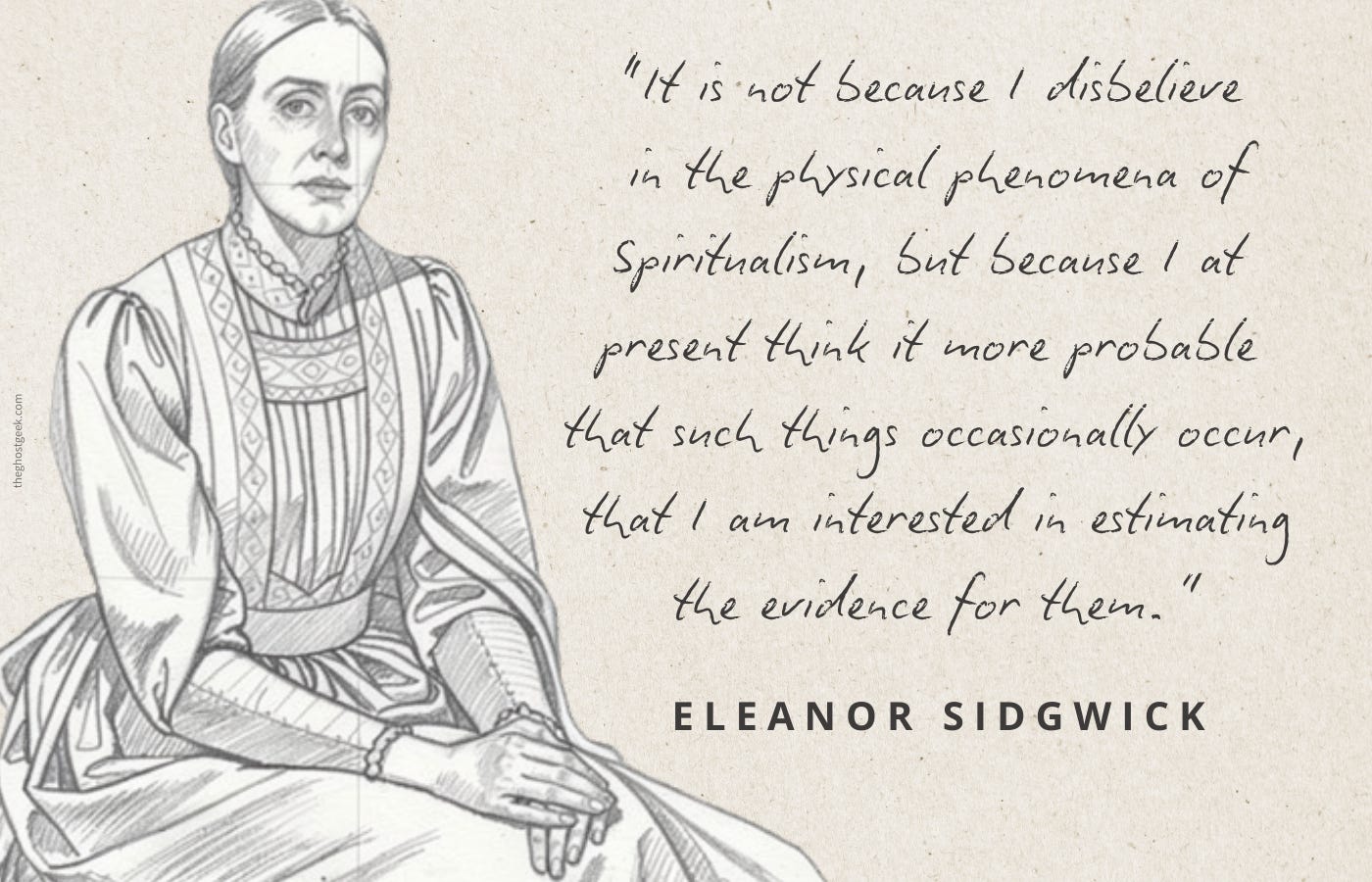
If you’ve been to one of my public talks you may remember my two golden rules of being a paranormal researcher:
how do I know that this is true?
what would it take for me to change my mind?
This is the basic way in which I check myself to ensure I’m not being closed-minded when I consider a case that I’m working on. Am I making any assumptions? Who does my conclusion serve? So no, my skepticism isn’t a locked door, and here’s a fun fact: changing your worldview isn’t actually that scary, and I’d be delighted to accept that ghosts are real.
What “evidence” means in practice
When I point out there’s a lack of evidence for a paranormal claim, I’m sometimes met with the same refrain - a skeptic could be shown evidence of a genuine poltergeist and still refuse to accept it. The implication is that skepticism is just stubbornness, and that asking for evidence is somehow an extraordinary demand.
But when evidence is presented and I say it’s poor quality or doesn’t show what it’s claimed to show, the response is often the same dismissal. This suggests the issue isn’t that I’m impossible to convince, but that the standards for what counts as convincing evidence are too low.
Asking for evidence is not unacceptable, and asking for adequate evidence is not bad faith. If that feels unreasonable, the problem isn’t with my skepticism - it’s with the quality of the evidence being asked to carry some very confident conclusions.
The gulf between “that is strange” and “that is definitely a ghost” is precisely where good method matters. It’s where we test alternative explanations, ask about context, double-check timelines, or clarify whether something is genuinely anomalous or just ambiguous.
If the explanation is true, it should survive basic challenge. That’s not cynicism, but instead a respect for reality.
This is one of the deep differences in how people approach the paranormal. I don’t accept most of the evidence presented to me as proof of ghosts because I think certainty is for the arrogant.
I acknowledge that there are experiences that are too strange to dismiss, too emotionally intense to trivialise, too powerful to mock - I’ve had them myself and written about them here, in fact.

But certainty - the kind that turns questions into insults and curiosity into tribal allegiance - is where communities start to harden. It’s where nuance gets punished and people get sorted into heroes and villains.
I’m not interested in that.
If anything, I think the most respectful posture we can take toward the unknown is humble uncertainty.
The dreaded armchair skeptics
I’ll be honest, I’m sure armchair skeptics exist, but so do armchair believers.
The chair isn’t the issue.
The attitude is.
Someone who sneers at eye-witnesses without listening isn’t doing skepticism well. But someone who assumes that any question is an attack isn’t doing inquiry well either! When I’m critical, I’m critical of behaviour and claims - not of people for sport. I’m happy to be challenged on methodology and conclusions, and I try to offer that same standard back.
The best discussions I’ve ever had in paranormal spaces weren’t defined by agreement - they were defined by tone. Curiosity over conquest, shared excitement over scorekeeping, and a willingness to say, “I don’t know yet,” without turning that uncertainty into a moral failure.


Most of the people I meet in paranormal communities are thoughtful, kind, and genuinely curious. They want answers, but they also want to understand the questions properly. A small minority - on any side of the debate - seem far more interested in winning than learning.
I’m not really here for that brand of certainty.
I’m also aware that I’m a woman asking big questions in a space where certainty can be a status symbol. That sometimes changes the temperature of the room. I can live with disagreement but I won’t mistake hostility for insight.
If your whole position relies on turning skeptics into a cartoon villain who will “never accept anything as evidence,” you’re building a rhetorical shield around your own assumptions, and that’s a shame, because paranormal research and discussion is most interesting when we let it stay difficult.
So what does good skepticism look like here?
For me, it looks like this:
Respect the person, test the claim.
Start with curiosity, not correction.
Separate what happened from what it means.
Be honest about uncertainty.
Ask what would change your mind.
Don’t treat grief, fear, or trauma as entertainment.
Enjoy the mystery.
I’m not in paranormal communities to sneer from the edges, I’m here because I care about the stories we tell, the meanings we make, and the ethical responsibility we have when we interpret strange experiences - especially when those experiences involve vulnerable people, big emotions, or high stakes.
I don’t think skepticism is the opposite of wonder.
I think it’s one of the fundamental ways we protect it.
LOVE this. Will definitely be assigning to my students at the beginning of the term to help them get clarity on "skepticism."
excellent!