

You Know the Ghost Video Is Fake. So Why Can’t You Unsee It?
Recent research suggests that warning people about a deepfake can help reduce its influence, though may not make its impact disappear entirely.

Imagine a suspicious video making the rounds online. It seems to show a witness making a serious accusation, but the footage is not authentic. Instead, it was generated using an artificial intelligence model.
Fortunately, the video is quickly identified and labelled as a deepfake. Phew! Viewers are now told that what they are about to see is probably false. That should solve the problem, right?
Or maybe not.
A new study in Scientific Reports suggests that while identifying a deepfake can reduce its influence, it does not remove it entirely. Even when people were warned in advance that a video was likely to be false, the allegation it contained still shaped their judgement.
For those of us who are curious about paranormal evidence, this raises an intriguing question. What happens when a ghost video is revealed to be manipulated, misleading, or entirely artificial? Does exposing the unreliability of a recording actually remove its influence, or has the video already left us with something more persistent?
A Synthetic Accusation
Researchers Emily Spearing and colleagues conducted two experiments involving a total of 2,500 UK participants.
Participants first read a fictional briefing about a hit-and-run in which somebody had been seriously injured. Some received only this written information. Others then watched a short AI-generated video presented as a clip from a local community podcast.
In the video, an apparent witness claimed to have seen the crash and identified a local politician as the driver responsible.
Before watching it, some participants were shown a prominent warning:
WARNING: the following video has been flagged as a deepfake, and therefore the content is likely to be false.
The warning also briefly explained that a deepfake is a realistic AI-generated video depicting somebody saying or doing something that never actually happened.
Afterwards, participants answered questions about the incident, including how likely they thought it was that the politician had committed the crime.
The results were consistent in both experiments. People who watched the accusatory video judged the politician as more likely to be guilty than those who never saw it. The warning also helped: participants who saw the warning were more likely to identify the video as fake, find it less reliable, and were less swayed by the accusation.
Still, the warning did not erase the effect. Even those told in advance that the video was probably a deepfake judged the politician as more likely to be guilty than people who never saw the video containing the accusation.
This does not mean that warnings are pointless. They clearly changed how people evaluated the recording and reduced its impact. Yet recognising that evidence is unreliable and actually removing its influence appear to be two different psychological challenges.
What About Witness Credibility?
The researchers also investigated whether making the apparent witness in the video seem less credible would strengthen the warning.
Their first attempt involved presenting the witness with either a British or Indian accent. Based on previous research into accent bias, they predicted that British participants might perceive the Indian-accented witness as less credible.
Instead, the opposite happened. The Indian-accented version produced slightly higher guilt judgements and was perceived as more reliable and less likely to be fake.
The researchers suggest that participants may have found it easier to notice synthetic qualities in the accent they knew best. It’s an interesting idea, though it comes from exploratory analysis rather than being firmly established by the experiment.
In the second experiment, the credibility manipulation was more direct. The witness was introduced either as a respected local GP or as a publicity-seeking socialite with previous fraud convictions.
Describing her as untrustworthy made the accusation seem less reliable and led to lower guilt judgements. Yet this did not make the deepfake warning any more effective. Even when participants were told both that the video was probably fake and that the apparent witness it depicted was untrustworthy, the accusation still had some influence.
This does not mean that credibility is unimportant. Both the credibility of the source and the deepfake warning shaped people’s judgements. What the researchers found is that challenging the witness’s credibility did not make the warning any more protective.
Knowing It’s Fake Isn’t the Same as Forgetting It
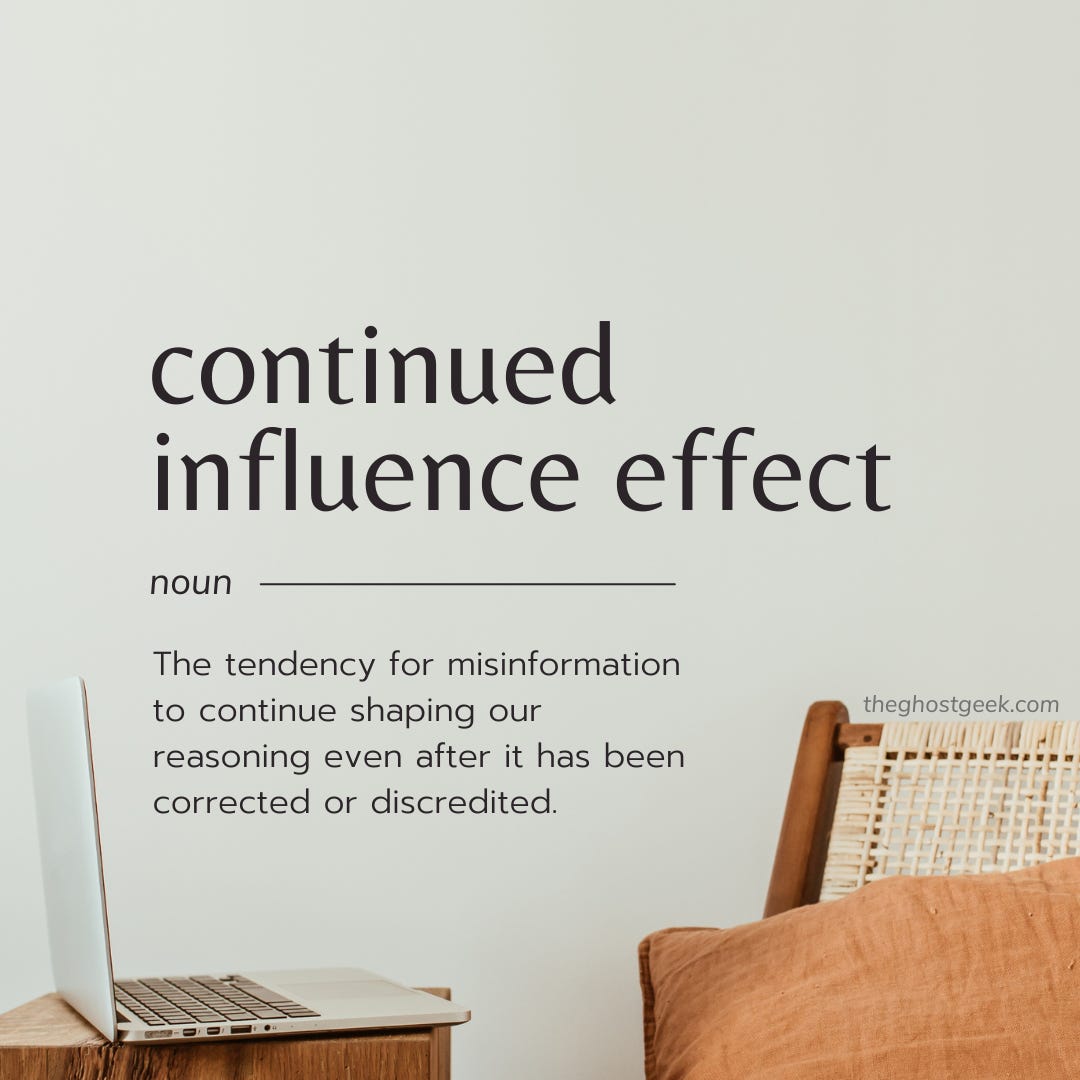
The authors connect their results to the “continued influence effect”, which is the tendency for misinformation to continue shaping reasoning after it has been corrected or discredited.
One possible explanation is that misleading information helps us construct a coherent story.
In this experiment, the deepfake offered an answer to an important question: who caused the crash? Taking away the accusation left a gap in the story. Without another explanation for the driver’s identity, the discredited claim remained the only answer available, and so it continued to shape people’s judgements.
This may be especially relevant to paranormal evidence.
A recording rarely reaches its audience without interpretation. Viewers are told that a faint sound is a dead child answering an investigator, that a blurred shape is a human figure crossing a corridor, or that a movement in the darkness is the ghost of somebody known to have died nearby.
The recording does more than provide pixels or soundwaves. It offers a story about what those ambiguous details might mean. It fills in the gaps, turning something vague into something that feels more coherent.
If the footage is later shown to be manipulated, misrepresented, or AI-generated, that may discredit the artefact. But discrediting the artefact does not, by itself, provide a replacement for the interpretation attached to it. The ghostly narrative remains, which is rather ironic when you think about it.
Saying “It isn’t a ghost” still leaves us with unanswered questions. What made the sound during the ghost hunt? Why did the shape seen by an eyewitness look so human? Why did someone feel a presence while trying to sleep? What caused the equipment to behave in unexpected ways?
When there is no alternative explanation, the supernatural story may remain the most vivid and complete account, even for someone who has good reason to doubt the original evidence.
Debunking the recording and correcting the story attached to it are not always the same thing.
What the Study Cannot Tell Us
There are important limits to how far these findings can be applied beyond the experiment itself. The study did not examine paranormal material, so applying its findings to ghost videos requires some careful inference.
In this study, participants were warned before seeing the video. This was not a case where people first accepted a recording as real and were only later shown a debunk. So the results do not directly show whether a correction given after exposure would fail to undo a deepfake’s influence.
The warning also told participants the video was “likely” to be false, rather than stating with certainty that it was fabricated.
There was also no comparison with an authentic video. The control group saw no accusation at all, so the study shows that the synthetic accusation influenced judgement even with a warning. It does not show that deepfakes are more persuasive than traditional misleading or misinterpreted videos or written misinformation.
Finally, the researchers changed the credibility of the person shown in the deepfake. In a paranormal case, the relevant source might be the investigator, uploader, editor, or commentator who tells viewers what the recording is supposed to show. Their expertise may be the thing a viewer already accepts or rejects.
Beyond Spotting the Fake
I have previously argued that the arrival of generative AI did not suddenly make photographic and video evidence unreliable. We should never have depended so heavily upon recordings as self-authenticating proof in the first place.

This research adds another layer to that idea, inviting us to look a little deeper.
The challenge is no longer just figuring out whether an image, voice, or video is genuine. We also need to consider how seeing it might shape the way we interpret everything that follows.
Effective sceptical communication may require more than simply labelling a recording as “fake.” Where possible, it should explain how the misleading claim was created, offer a plausible alternative account supported by evidence, and avoid repeatedly showing dramatic misinformation simply to condemn it.
There is a real risk of assuming that detecting AI-generated paranormal material is enough to neutralise its influence. This research suggests that identifying the fabrication may be only the first part of the task. Sceptical investigators must also consider the interpretation introduced by the recording, the unanswered questions it leaves behind, and what evidence would support a better account.
AI makes it easier than ever to create the ghost in the video. Psychology may help us understand why identifying the fabrication does not necessarily remove that ghost from our judgement.
The Ghost Geek is an award-winning science blog about spooky things, written by Hayley Stevens, a former ghost hunter who is now studying for a Master’s in Forensic Psychology and uses scientific scepticism to investigate strange claims.