


In 2016, operators of ghost-hunting events at The Stanley Hotel developed a new spirit-communication technique called the Estes Method. They aimed to prevent spirit-box sessions from being contaminated when everyone present hears both the question and the “answer” through the spirit box.
Anyone listening to a spirit-box session knows what could constitute an appropriate answer the moment the question is asked, so the idea is that if a person could not hear the questions while they listened to the spirit box, repeated back words they hear from it, and the answers they provide this way were related to the unheard question, that could be proof that the audio from the spirit box was legit spirit communication.
I wrote an analysis of the Estes Method back in 2019, outlining how the logic was simple as much as it was lacking. The Estes Method didn’t eliminate the fact that the spirit box itself isn’t a
good piece of equipment; it couldn’t eliminate auditory pareidolia, and the biggest issue remained the subjective interpretation of what was heard through the spirit box.
What the Blindfold Couldn’t Fix
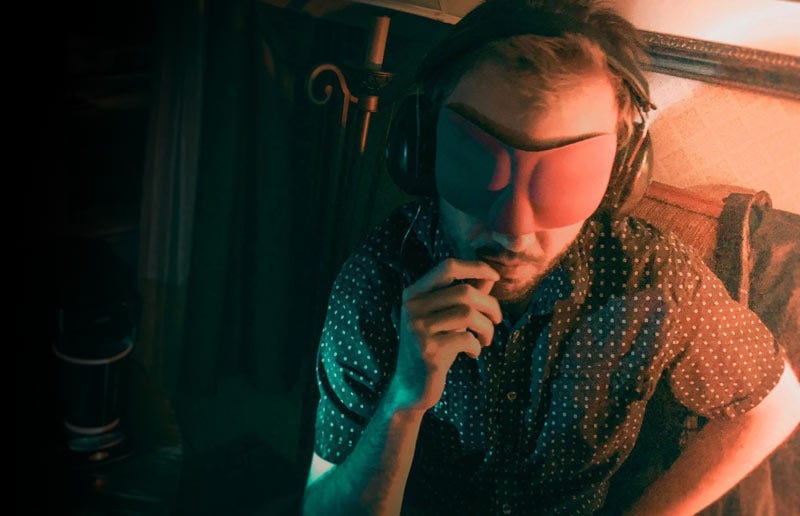
The listener - or receiver, as they’re called in the procedure - still knows about the haunting and ghost story attached to the place they’re sitting in, right? Removing their ability to hear the question being asked does not remove underlying bias and suggestion from the process. Not only does their existing knowledge of the haunting affect the outcome of the Estes Method, but even their own preceding words can influence what they hear next. Someone who has just interpreted an audio fragment as “mother” is now primed for related speech.
Research into Electronic Voice Phenomena (EVP) has found that paranormal framing can increase reports of voices in ambiguous audio. Nees and Philips found that a paranormal prime increased perceived voices in both purported EVP and degraded speech recordings. More recently, research has continued to examine how priming affects pareidolia in people reporting paranormal experiences, including a 2022 study by Williams and Balgrove.
This suggests that people participating in the Estes Method might sincerely hear something the audio source does not unambiguously contain and believe it is relevant, because perception is constructive and shaped by paranormal framing.
As the Estes Method spread over the last decade, even that limited attempt at control has been reduced to its most visible props. As a result, what remains is not a controlled experiment in any sense but an improvisational séance whose ambiguity is mistaken for validation.
Not only that, but the method can now be purchased as a kit for as little as £100, booked as a ghost-hunting tourist experience, and endlessly modified without any agreed centralised evidential standard.
To put it bluntly: the original methodological problems I wrote about in 2019 remain, the method has drifted substantially since then, and its current form serves entertainment and commerce far better than it functions as a controlled investigation technique.
The Estes Method: A Scientific Examination

The Estes Method is the latest trend sweeping through ghost-hunting circles. It claims to offer a more accurate way of communicating with spirits.
When The Props Become The Method
In 2026, claiming to use the Estes Method can mean little more than ‘someone is listening to ambiguous audio through headphones’ and, frankly, that’s exactly how we should treat claims about this method before they’re ever considered as a scientific attempt to conduct spirit communication.
The evolution of the Estes Method shows how easily the appearance of scientific control can outlive the control itself. Put a blindfold on someone, cover their ears with large headphones, call them a receiver, and the whole performance looks pleasingly experimental - even if nobody has actually decided what would constitute a successful result, or more importantly, what would count as a failure.
One guide for using the “solo” Estes Method suggests using shuffled pre-recorded questions and allows the receiver to remain sighted where wearing a blindfold would be unsafe. This might be a sensible safety decision, but it clearly shows how the Estes Method no longer denotes a single replicable procedure. In fact, the solo method guide actually recommends altering the sweep rate and band of your spirit-box if you’re “not getting much” - which is a great example of changing conditions until interesting output appears.
I hate to break it to you, but that is not good scientific technique.
The Experiment in a Box
GhostStop currently sells an “Estes Method Spirit Box Ghost Hunting Kit” for $139.95. SpiritShack likewise offers a “Ghost Box, Headphones and Blindfold” kit in the UK for approximately £99. The UK listing calls it a technique for enhancing spirit communication.
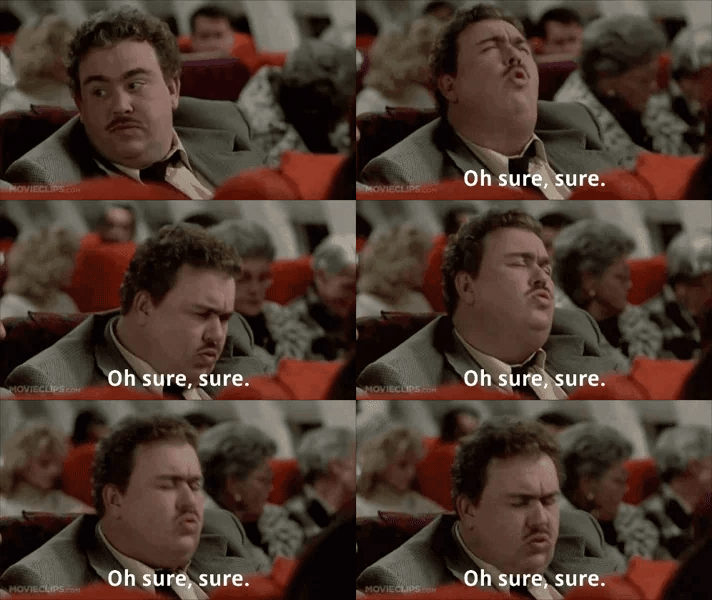
Elsewhere, one commercial ghost experience gives guests disposable blindfolds, headphones, and spirit boxes, and promises souvenir recordings you can take home. It’s promoted as an experiment like those seen on ghost-hunting television. The tour description is unusually clear evidence of the transition from proposed investigative technique to packaged immersive entertainment.
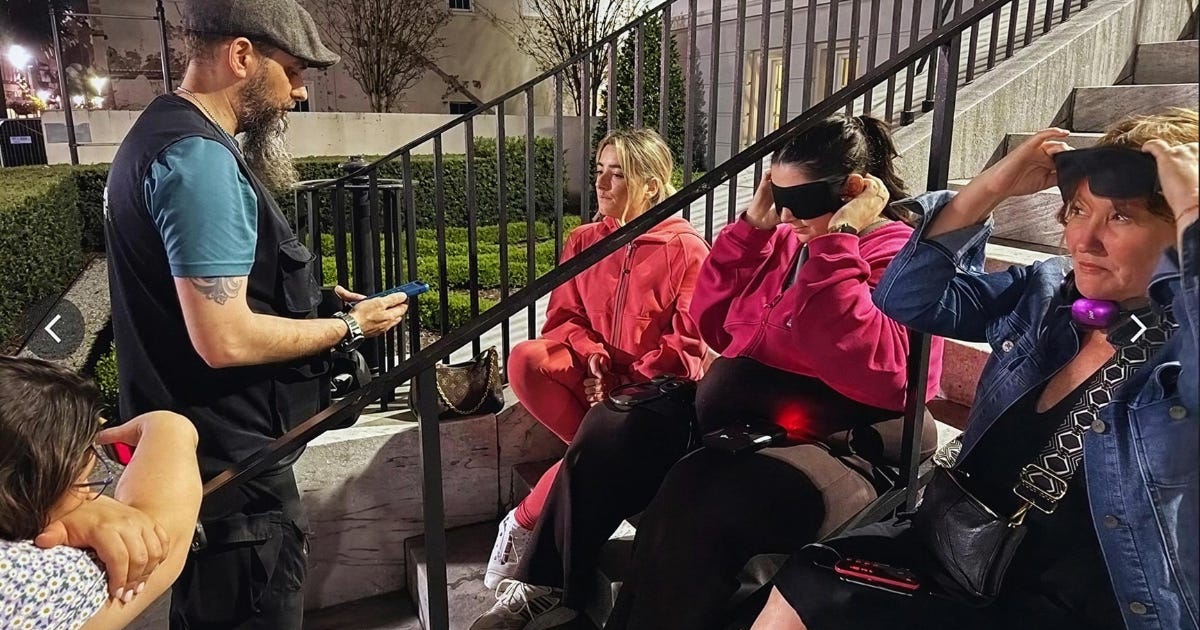
Further variations move even further away from the original procedure first presented back in 2016. Some replace the spirit box’s radio sweep with apps that use stored noise or reversed human phonemes (speech sounds). Other variations use several receivers at the same time, often interpreting coincidental exchanges between separate audio streams as meaningful conversations.
You can see an example of this in the video below from about the 5:26 mark:
The ghost hunters in this video interpret what happens as ‘the conversation started to shift in a way that suggested we were talking to two entities’ in their written report. They also suggest the entities appeared to be “talking to each other as well”, and invite us as viewers to interpret the second session as a discussion between a jailer and prisoner, or between two prisoners.
This shows how adding a second receiver dramatically increases ambiguous material and how two or more separate streams of radio fragments are quickly assembled into one narrative in the moment. You can also see another investigator relaying one receiver’s words, adding another interpretative layer, while not being blinded to the questions being asked.
The video also shows the Estes Method isn’t used in isolation. Other ghost hunting techniques are used in the room, producing further ambiguous events that are treated as corroborating one another. It’s all very distracting and a little chaotic, but hey… It’s ghost hunting!
The Estes Method has even been combined with psychometry and spirit mediumship, with the receiver reporting impressions rather than merely repeating audible fragments. All of these variations make different claims, are based on different assumptions, generate different kinds of materials, and introduce different sources of interpretation all under the same method name.
These adaptations, products, and commercial experiences show how the term Estes Method is now being applied to a range of substantially different practices designed to please the user more than produce any useful data from a controlled condition.
It’s all very bleak.
The genuinely important components of a controlled test- pre-established criteria, control trials, independent evaluation, full reporting, including pre-registration of experimental intention - are precisely the things that cannot be included in the kits sold on e-commerce sites, and which are absent in ghost hunting contexts in which the Estes Method is used.
Essentially, the Estes Method has retained the look of experimental control while becoming increasingly detached from the substance. It’s procedural theatre that does none of the hard work of experimental science but tries to claim the same rigour, and I take real issue with ghost hunters using terminology like experiment, evidence, controlled, and results when there is literally no controlled comparison.
Everything Becomes a Ouija Board in the End
I don’t know whether the inventors of the Estes Method intended this outcome or could even envision it all those years ago, but it really isn't a surprise, as this seems to be the curse of the ghost-hunting community that they just can’t shake.
There’s a familiar pattern in ghost hunting: something is introduced to provide some measurement or control, only for its ambiguous output to be treated as a means of conducting a conversation with ghosts.
It happened when ghost hunters started using Electromagnetic Field meters for their intended purpose, then ended up using them as “yes or no” devices instead, asking ghosts to make the meter light up in response to questions.
Ghost hunting is a séance where participants are very likely to wear tac gear for some reason, and that’s okay as long as nobody mistakes the costume for scientific credibility.
The problem with the modern Estes Method isn’t that it creates an uncanny experience, but that the features that make it so effective prevent it from demonstrating what its practitioners claim. Its flaws are not obstacles to its success - they’re what make the whole experience work.
The Ghost Geek is an award-winning science blog about spooky things, written by Hayley Stevens, a former ghost hunter who is now studying for a Master’s in Forensic Psychology and uses scientific scepticism to investigate strange claims.